'%20stroke='none'%20/%3e%3cpath%20fill-rule='evenodd'%20clip-rule='evenodd'%20d='M9.59162%2022.7357C9.49492%2022.6109%209.49492%2021.4986%209.59162%2019.399C8.55572%2019.4347%207.90122%2019.3628%207.62812%2019.1833C7.21852%2018.9139%206.80842%2018.0833%206.44457%2017.4979C6.08072%2016.9125%205.27312%2016.8199%204.94702%2016.6891C4.62091%2016.5582%204.53905%2016.0247%205.84562%2016.4282C7.15222%2016.8316%207.21592%2017.9303%207.62812%2018.1872C8.04032%2018.4441%209.02572%2018.3317%209.47242%2018.1259C9.91907%2017.9201%209.88622%2017.1538%209.96587%2016.8503C10.0666%2016.5669%209.71162%2016.5041%209.70382%2016.5018C9.26777%2016.5018%206.97697%2016.0036%206.34772%2013.7852C5.71852%2011.5669%206.52907%2010.117%206.96147%209.49369C7.24972%209.07814%207.22422%208.19254%206.88497%206.83679C8.11677%206.67939%209.06732%207.06709%209.73672%207.99999C9.73737%208.00534%2010.6143%207.47854%2012.0001%207.47854C13.386%207.47854%2013.8777%207.90764%2014.2571%207.99999C14.6365%208.09234%2014.94%206.36699%2017.2834%206.83679C16.7942%207.79839%2016.3844%208.99999%2016.6972%209.49369C17.0099%209.98739%2018.2372%2011.5573%2017.4833%2013.7852C16.9807%2015.2706%2015.9927%2016.1761%2014.5192%2016.5018C14.3502%2016.5557%2014.2658%2016.6427%2014.2658%2016.7627C14.2658%2016.9427%2014.4942%2016.9624%2014.8233%2017.8058C15.0426%2018.368%2015.0585%2019.9739%2014.8708%2022.6234C14.3953%2022.7445%2014.0254%2022.8257%2013.7611%2022.8673C13.2924%2022.9409%2012.7835%2022.9822%2012.2834%2022.9982C11.7834%2023.0141%2011.6098%2023.0123%2010.9185%2022.948C10.4577%2022.9051%2010.0154%2022.8343%209.59162%2022.7357Z'%20fill='rgba(0,0,0,0.7)'%20stroke='none'%20/%3e%3c/svg%3e)
Autogeneration for DDR/ITG stepcharts using AI
Dance Dance Revolution (DDR) and its modern counterpart, In the Groove (ITG), are popular rhythm games in which players step on arrows in time with music and are scored based on how well they match the timing of the arrows. The process of creating a DDR/ITG stepchart is challenging, requiring both musical knowledge and deep understanding of game mechanics.
In Dance Dance ConvLSTM (DDCL), I first explored the use of machine learning to generate stepcharts for DDR/ITG. This work was an extension of Dance Dance Convolution (DDC), which used a convolutional/LSTM (CNN-LSTM) network structure to generate stepcharts. DDCL instead employs a ConvLSTM based architecture and beat based sample modulation. The performance improvement was significant, as was the visible improvement to generation quality.
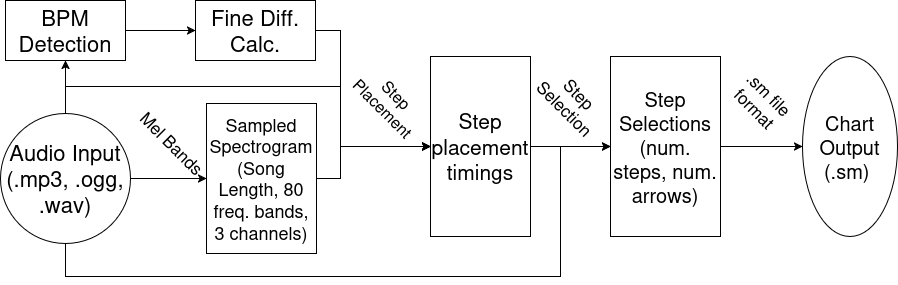
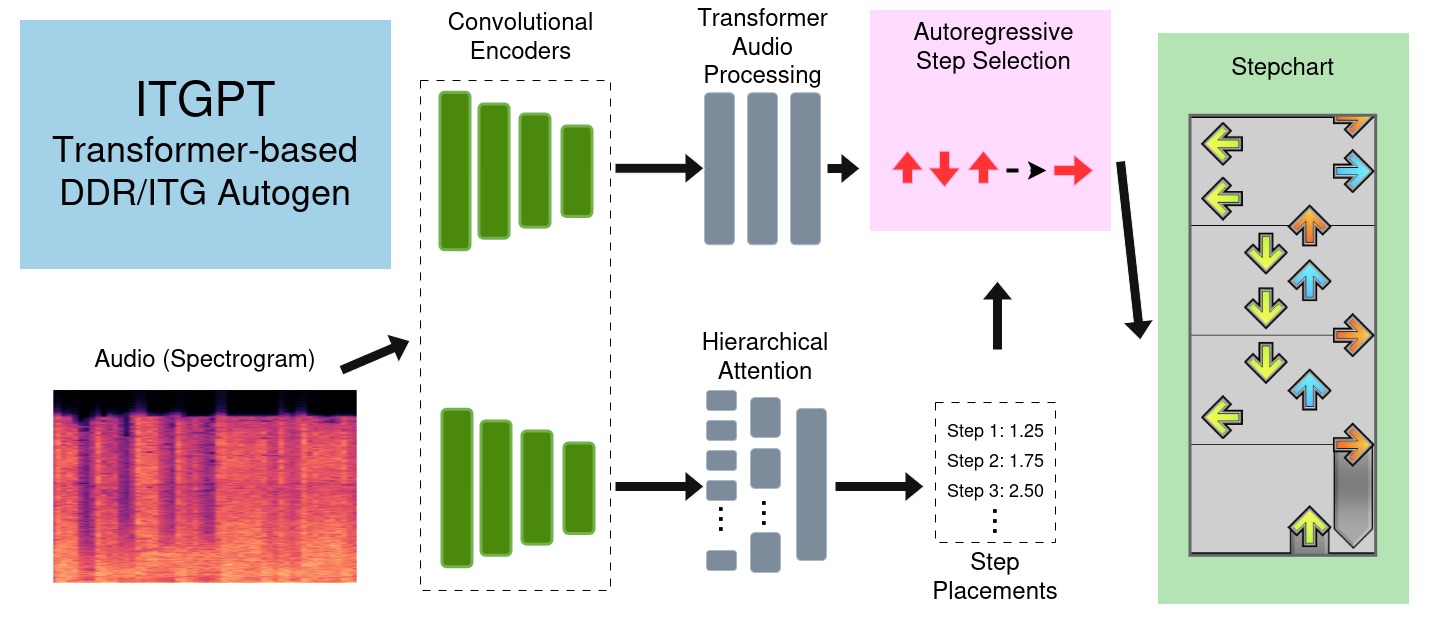
DDCL represented a significant step forward, but did not include any transformer integration. In ITGPT, I explored the use of transformers to generate stepcharts for DDR/ITG. This idea was not wholly new to Rhythm games, but the use of a DDR/ITG native model (as opposed to one built through transfer learning) was novel. To better fit the task, I incorporated hierarchical encoding for the onset placement model, a diagnostic model to control for auxiliary parameters, and a much larger and faster step selection model. For DDR/ITG stepcharting, ITGPT is highly accurate compared to existing models, and lightning fast.
Try ITGPT!
- ITGPT: A Transformer Based Architecture for the Generation of Dance Dance Revolution and In the Groove Charts. Miguel O'Malley. 2026.
- Dance Dance ConvLSTM. Miguel O'Malley. 2025.